A citation for every answer
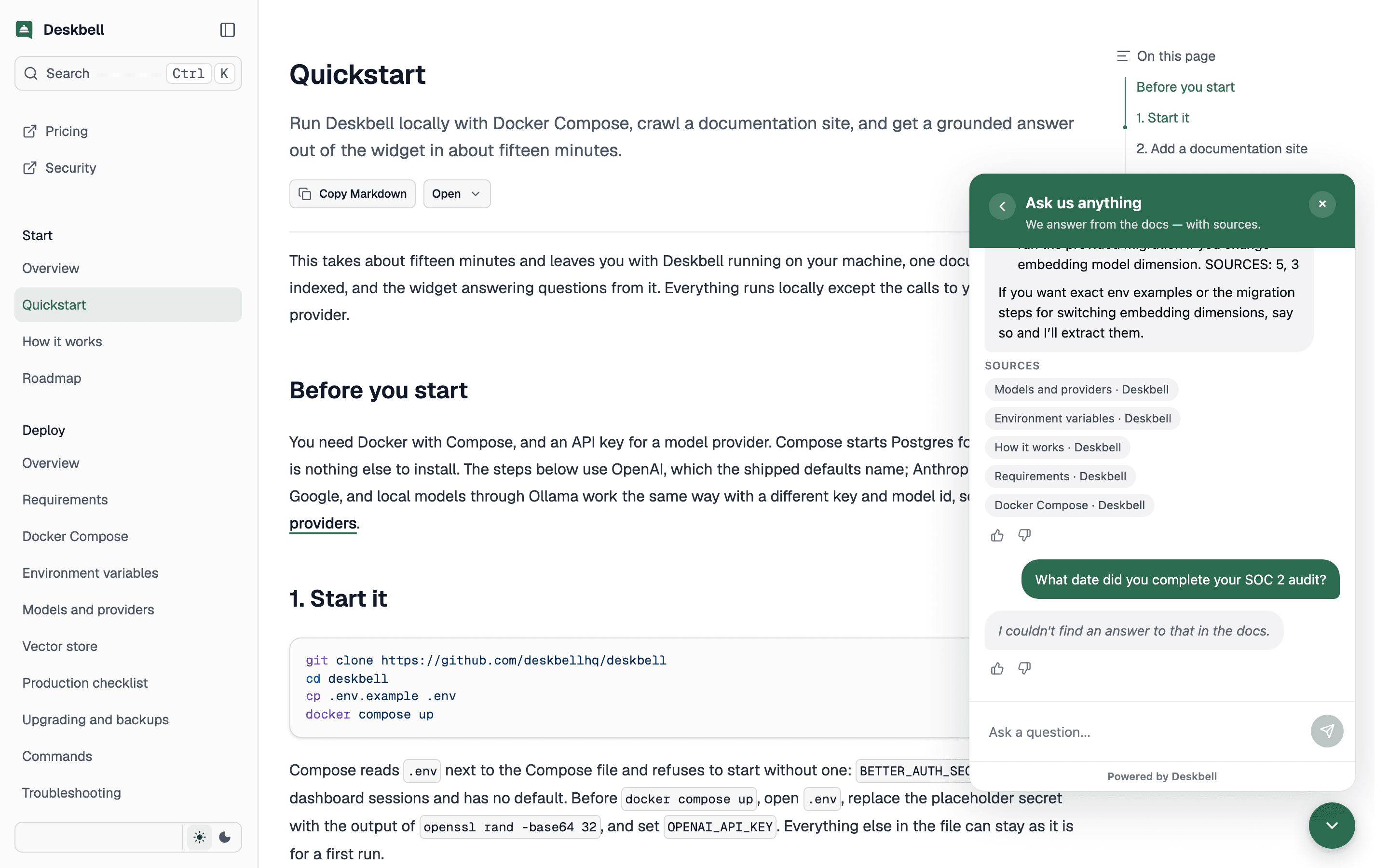
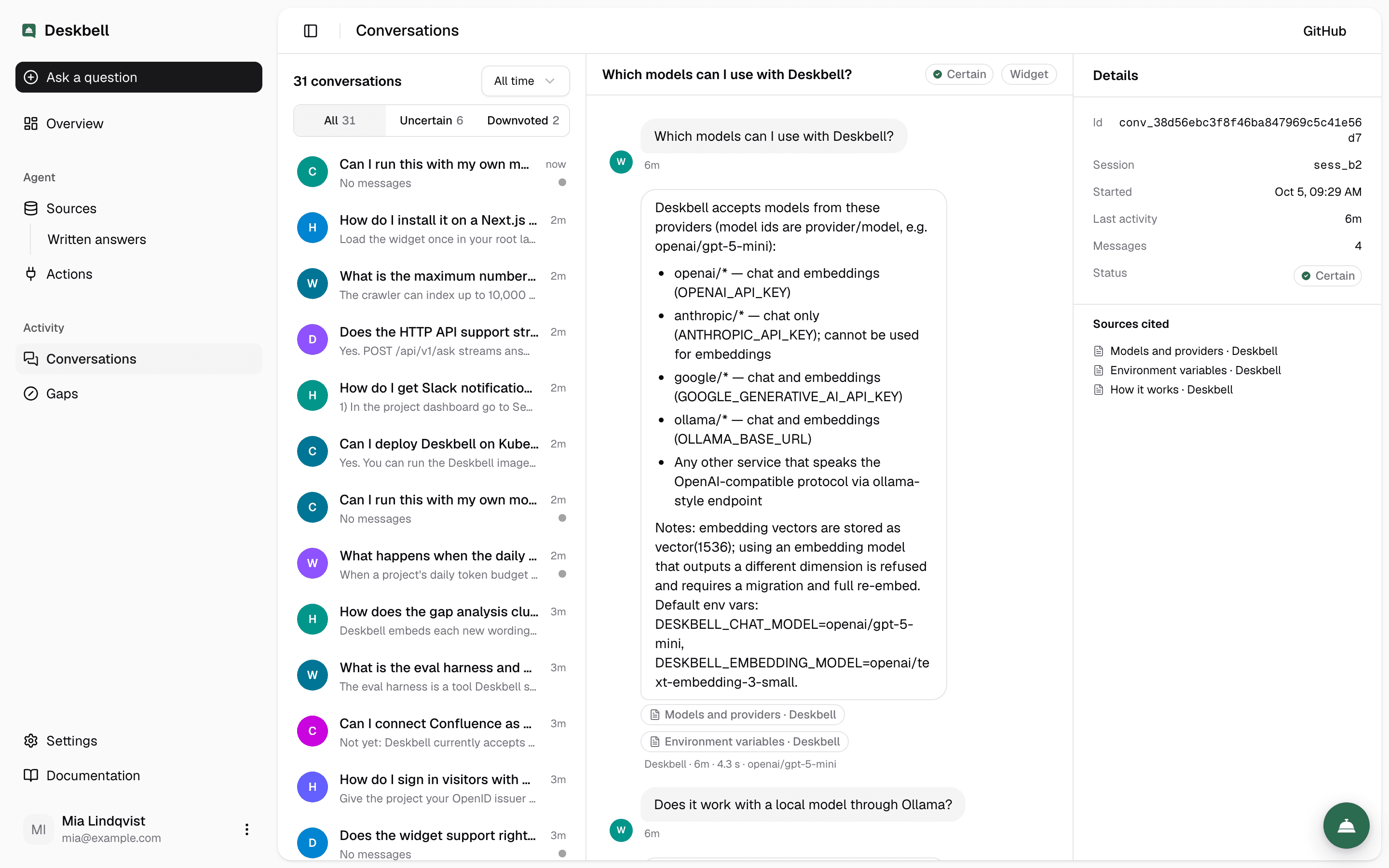
The model names the chunks it used; only those become citations, each linked to the page it came from.
Deskbell answers your users’ questions from your docs, with a source on every answer and a refusal when the docs don’t say. Self-hosted, any model, your brand. Built for devtools and B2B SaaS teams with public documentation.
Free to self-host · AGPL-3.0 core, MIT widget
How it works
1
Paste a URL on the Sources page. Deskbell reads the sitemap, respects robots.txt, then crawls, chunks and embeds into Postgres.
Dashboard → Sources
https://docs.your-product.com2
One variable for answering, one for embeddings. Switching providers changes nothing else in the deployment.
.env
DESKBELL_CHAT_MODEL=anthropic/claude-sonnet-5
DESKBELL_EMBEDDING_MODEL=openai/text-embedding-3-small
3
Served from your own deployment. The widget renders in a shadow root, so it inherits nothing from your CSS and leaks nothing into it.
your docs template
<script async src="https://deskbell.your-product.com/deskbell.js" data-project-key="pk_live_…"></script>Features
The model names the chunks it used; only those become citations, each linked to the page it came from.
No answer in the retrieved context means a refusal, not prose. What was retrieved is kept, so you can see why.
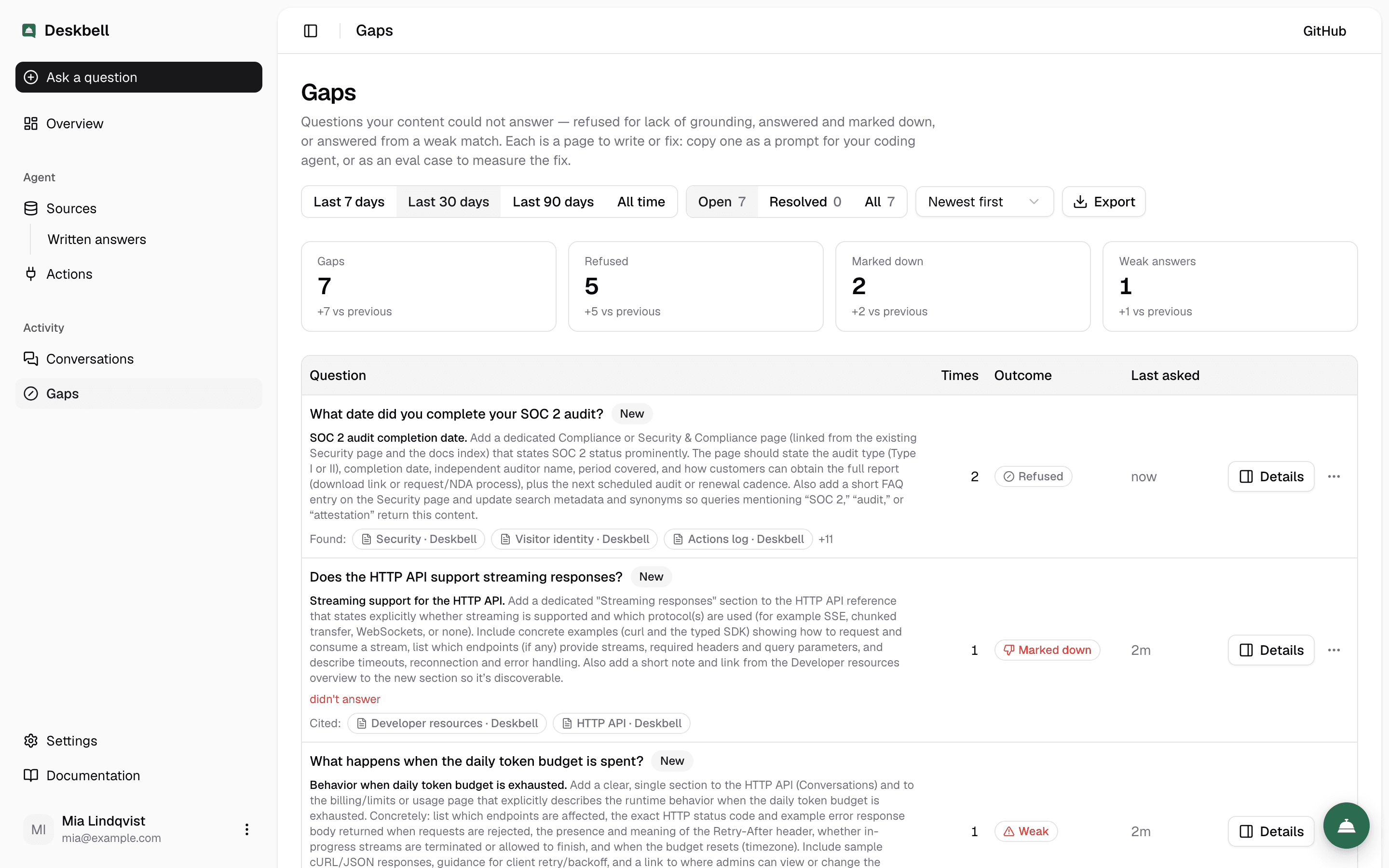
Unanswered, downvoted and weakly answered questions, clustered by meaning, with a trend against the previous period. Write the missing answer in the dashboard and it is indexed and cited like a page.
Recall, precision, MRR and nDCG for retrieval; factuality and groundedness for answers, reported separately so neither hides the other.
Theme tokens for colour and type, CSS parts for shape, slots for the launcher and header. It renders in a shadow root, so it inherits nothing from your page and breaks nothing on it.
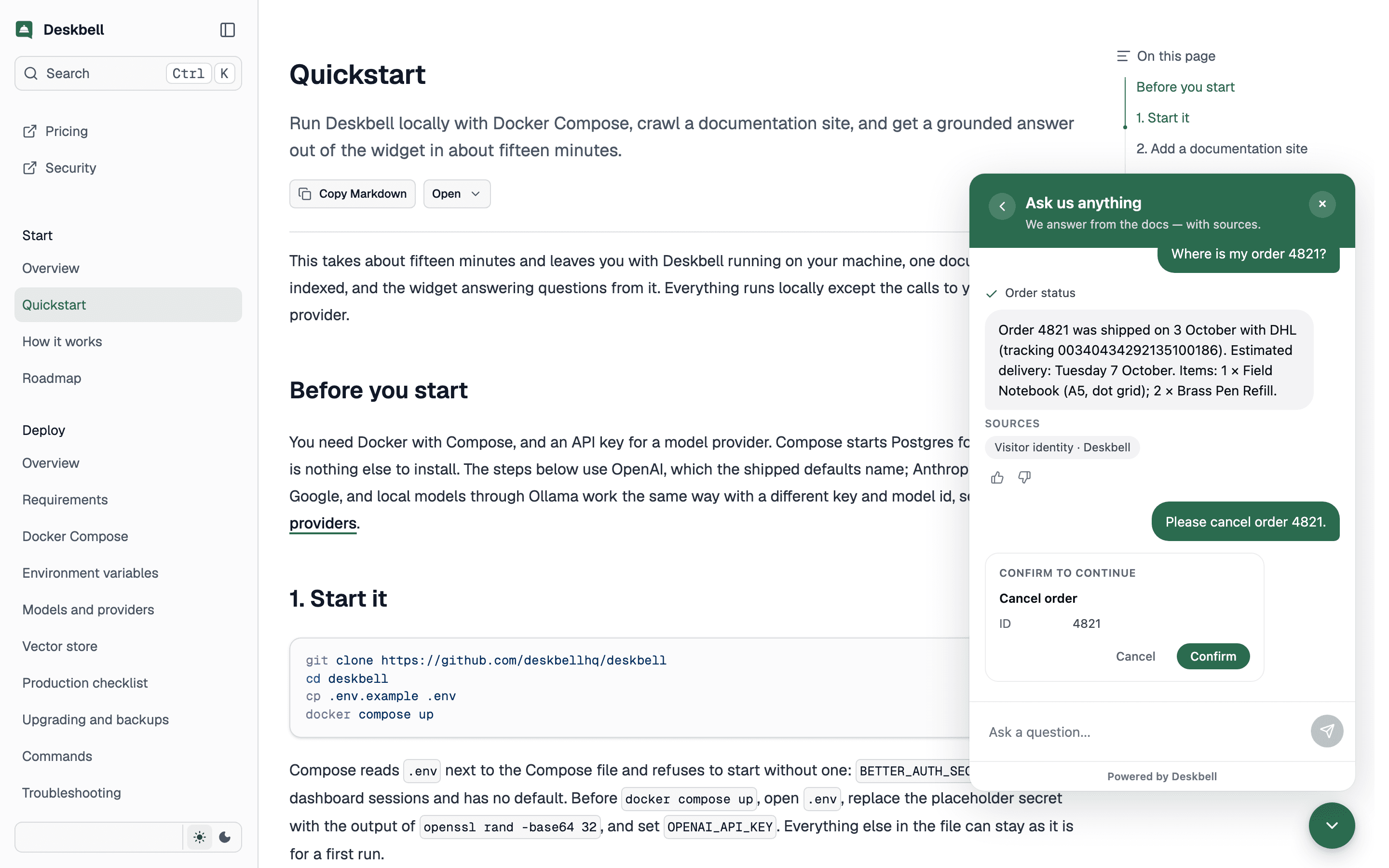
Attach any MCP server. Every tool starts off; a lookup can be allowed, a write needs the visitor's confirmation. Each call is logged with who asked and what ran.
Bring your own
Provider SDKs live in one module and the vector store behind one interface, so none of these choices leaks into the rest of the deployment.
Models
Storage
Your site
Identity
Self-hosted
Install
git clone https://github.com/deskbellhq/deskbell
cd deskbell
cp .env.example .env
docker compose up
Set BETTER_AUTH_SECRET and a model API key in .env first. Requirements: Docker with Compose. Production checklist
Compared
A hosted docs bot is a service you subscribe to. Deskbell is software you run: the model, the database and the conversations are yours, and the quality is something you can measure instead of take on trust.
| Capability | Deskbell | Hosted docs bots |
|---|---|---|
| Where it runs | Your servers. Docker Compose, Postgres is the only service. | The vendor's cloud. |
| Where conversations live | Your database, your region. Visitor IPs are never stored. | The vendor's servers; regional hosting is typically an enterprise feature. |
| Model | OpenAI, Anthropic, Google, or a local model. Two variables to switch. | The vendor's choice. |
| Citations and refusals | A source on every answer; a refusal, kept with its retrieved context, when the docs don't say. | Varies by product. |
| Unanswered questions | Clustered by meaning, with a trend and a written recommendation per cluster. | Varies by product. |
| Actions | Any MCP server's tools, each off, allowed or needs-confirmation; writes wait for the visitor's confirmation. | The vendor's own integrations, or none. |
| Quality you can measure | An eval harness you run in CI, on your corpus, with your judge. | Not something you can run. |
| Price | $0 to license. You pay for Postgres and model tokens. | Per answer, or on request. |
| Source | AGPL-3.0 core, MIT widget and SDKs. | Closed. |
Pricing and licensing
$0 to license, unlimited questions, no per-question or per-seat metering, instead of a hosted docs bot billed per answer. You pay for your own Postgres and your own model tokens, or nothing at all with a local model.
The answering core is AGPL-3.0, the widget and SDKs are MIT, and the operations plane is the only commercial part, which isn’t sold yet.
| Layer | What’s in it | License |
|---|---|---|
| The answering coreRetrieval, grounding, citations, refusals, connectors, eval harness | Retrieval, grounding, citations, refusals, connectors, eval harness | AGPL-3.0 |
| Everything that touches your page or codeWidget, web component, React wrapper, typed client, UI kit | Widget, web component, React wrapper, typed client, UI kit | MIT |
| The operations planeMulti-organisation management, SSO/SCIM, audit log, white-label rights | Multi-organisation management, SSO/SCIM, audit log, white-label rights | Commercial |
The boundary is written in the repository’s LICENSE and packages/ee/FEATURES. Pricing and licensing in detail
Roadmap
Not on the roadmap: a helpdesk. Deskbell overlays the one you have.
Questions
Nothing to license. You pay for a Postgres instance and for tokens from the model provider you choose, or nothing at all with a local model through Ollama. There is no per-question metering and no seat cap.
OpenAI, Anthropic, Google, any local model served through Ollama, and anything that speaks the OpenAI-compatible protocol, such as vLLM, LM Studio or llama.cpp. Switching is a configuration change.
Docker with Compose and an API key for a model provider. Compose starts Postgres; vectors and the job queue live in the same database, so there is no Redis, no Kafka and no separate vector store.
No. Deskbell overlays whatever you already run. It answers what your documentation covers and, on the roadmap, hands the rest to a human in your existing tool.
Yes, through MCP. Attach any MCP server to a project and its tools appear in the dashboard, every one off by default. A lookup can be set to allowed; a write is set to needs-confirmation, so the model may propose it but it runs only after the visitor confirms a card. The visitor's identity reaches the server as a signed token and every call lands in an audit log, because a public widget with write access is a prompt-injection target.
Conversations stay in your database and your region, and visitor IP addresses are never stored. The only outbound call is to the model provider you picked; a local model removes it.
A weekend build gets you retrieval and a chat box. What it skips is the part that makes the answers safe to put in front of users: refusing when the retrieved context does not answer, keeping citations honest, clustering the questions the docs could not answer, and an eval harness that tells you whether a change made answers better or worse. Those are most of Deskbell, and they are the parts that keep needing work.
Kapa is hosted software: you cannot run it yourself and every widget query goes through Kapa's servers. Deskbell runs on your infrastructure with any model and is free to self-host. Kapa is more mature today.
Clone it, add a documentation URL, then ask it something the docs answer and something they don’t.
Want to contribute? Good first issues