Knowledge
What Deskbell answers from, the two kinds of source, the states a source moves through, and what happens to a page between the crawl and the first citation.
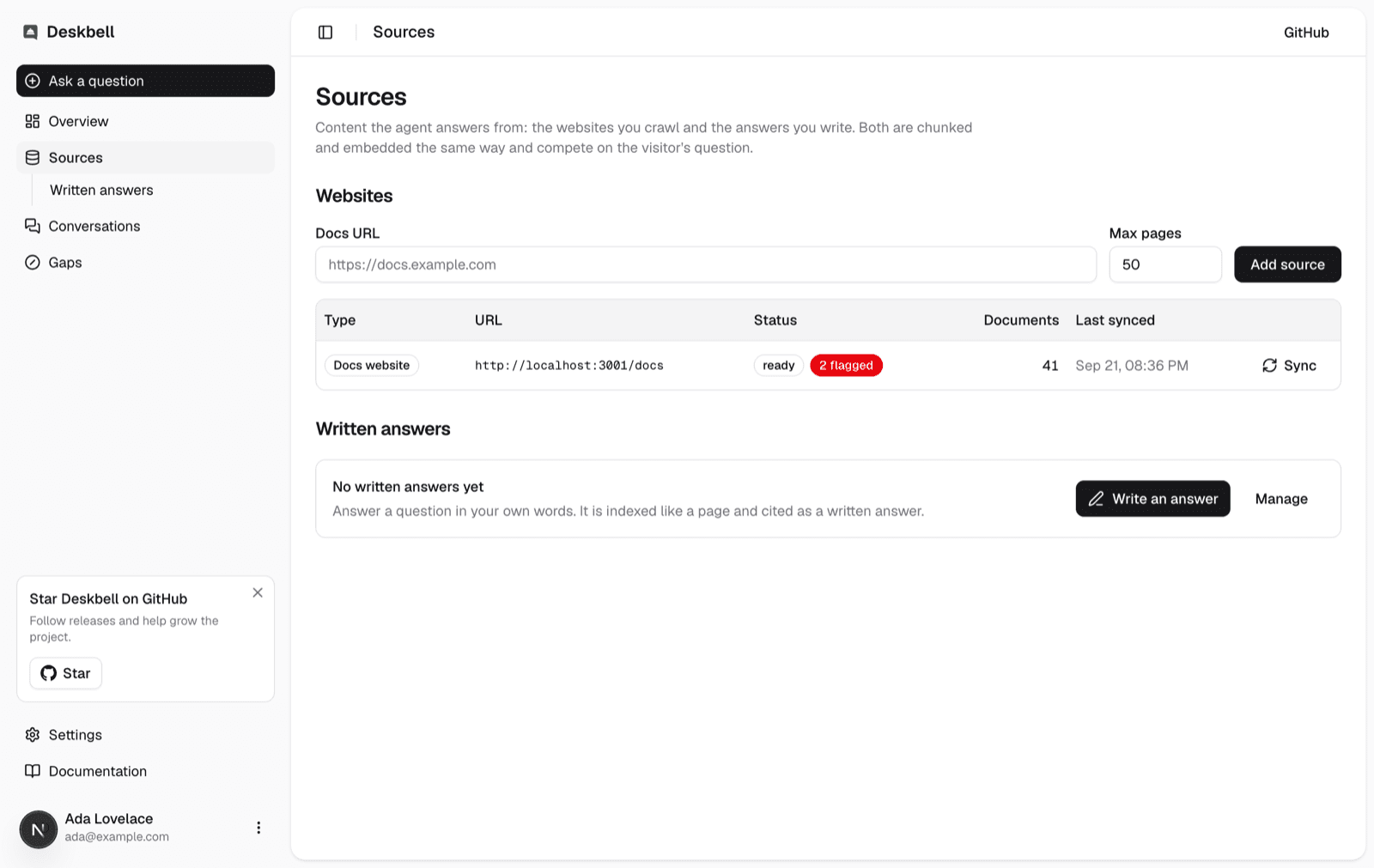
Deskbell answers from what you give it and nothing else. Its knowledge is a set of sources on the Sources page of the dashboard; every answer cites the pages it drew on, and a question that none of them cover is refused.
Two kinds of source
| Source | Where it comes from | Cited as |
|---|---|---|
| Website | A documentation site, crawled from a start URL by the worker | The page, linked |
| Written answers | Question and answer pairs typed in the dashboard, usually from a gap | A written answer, labelled as one |
A project holds any number of websites and one written-answers source, created the first time an answer is saved. Both are indexed the same way and compete on the same terms at retrieval; a written answer wins by matching the question better, not by rank.
What happens to a page
- Fetch. The crawler reads
robots.txt, prefers the sitemap, falls back to links, and identifies itself asDeskbellBot. - Extract. The page is reduced to its main content: headings and paragraphs, with navigation, headers and footers dropped.
- Chunk. Blocks are packed into chunks of about 2,800 characters with 350 characters of overlap, so an answer is not cut in half at a boundary. The sizes are environment variables.
- Check. Each chunk is tested against four injection heuristics. A match is recorded and counted on the source row; the chunk still answers.
- Embed. Each chunk is embedded with the configured model and stored in Postgres with its vector, its document, and the model version that produced it.
A written answer skips the first two steps: its text is the question as a heading followed by the answer, then chunked and embedded like a page.
Source states
| State | Meaning |
|---|---|
pending | Added, waiting for the worker to pick it up |
syncing | The worker is crawling, chunking or embedding it |
ready | Every chunk is stored and answerable. The row shows page and chunk counts and the last sync time |
error | The crawl failed. The worker log says why; Sync runs it again |
Ingestion runs in the worker, so docker compose logs -f worker is where the
detail is. A source that stays pending with no chunks is usually a model
provider problem rather than a crawl problem, because embedding is the first
step that calls the provider. Troubleshooting
lists the cases.
When a question has more than one reading
Retrieval can come back with pages that answer the same question differently, because the visitor did not say which of several things they meant. The assistant can ask which one instead of answering for the one the model picked; Clarifying questions covers the setting, what it costs and what it says about your content.
Keeping it current
Sync on a source row crawls again. Pages whose content hash is unchanged are skipped; changed and new pages are re-chunked and re-embedded. A written answer is re-indexed when it is edited.
Changing the embedding model, or moving the index to another vector store, means every chunk has to be embedded again. The Sources page shows how many chunks are behind and a Re-embed button; Re-indexing describes the job.
Troubleshooting
The failures a first deployment runs into, what each one looks like, which log shows it, and the fix, from a source stuck at pending to a widget that refuses every origin.
Website
The crawler discovers your sitemap, honours robots.txt, extracts the main content of each page, and splits it into overlapping chunks for embedding.